I had put together this hand-out for brewing classes I teach in the SCA. I put it here now for your amusement.
Brewing Glossary
Lord Donndubán Ó Domhnaill (Donovan O’Donnell)
Ale is a beer that uses a type of yeast called Saccharomyces cerevisiae, or “top-fermenting” yeast as opposed to a Lager (Saccharomyces uvarum) or “bottom-fermenting.” During the late middle ages, the term was used to describe a malt beverage that was flavored with herbs other than hops. It would otherwise be known as beer. Beer is used to describe all malt beverages today.
Atenveldt Brewers Guild is the guild in the Kingdom of Atenveldt whose membership organizes brewing competitions and other events. Gain rank by demonstrating your knowledge of the brewing arts.
Beer is the fermented product of grains such as barley and wheat. Today the term is used to refer to any ale or lager. During the late middle ages, the term was used to refer to a malt beverage that was flavored with hops instead of with other herbs.
Cyser is mead made with apples or apple juice.
Cool is a term that is used to describe anyone that remembers to enter brewing into kingdom or baronial arts and sciences competitions.
Distillation is the harvesting and concentration of alcohol from another source. This is still illegal to do without licensing in the United States.
DonDehm.com is a place you can go to get step-by-step instructions on brewing your first beer or mead.
Fermentation is a metabolic process converting sugar to acids, gases and/or alcohol by yeast or bacteria. In our case, it is the conversion of sugar by yeast into alcohol.
Gruit is an herbal mixture that was used before hops became popular. Some herbs used included ground ivy, bog myrtle, carline thistle, yarrow, wild rosemary, heather, wormwood, sycamore sap, spruce, ginger, anise, cumin, laurel, marjoram, mint, sage, and acorns.
Hops is an herb used to help in the preservation and flavoring of beer. The first recorded cultivation of hops was in a monastery in Bavaria 736 AD. The first documentation association of hops used in brewing is in 822 AD by Abbot Adalhard of a Benedictine monastery in Northern France.
Lager is a beer that uses a type of yeast called Saccharomyces uvarum, or “bottom-fermenting” yeast as opposed to a Ale (Saccharomyces cerevisiae) or “toop-fermenting.” Lager brewing existed in Bavaria from the 1400s.
Malt is grain that has been allowed to germinate for a couple of days, thus releasing important proteins and sugars that are used to make beer.
Mead is a fermented product of honey and water.
Melomel is mead with added fruit.
Methoglyn is mead with added herbs.
Reinheitsgebot is the Bavarian Purity Law of 1516 which stated that beer could only be made from barley, hops, and water.
Yeast are fungal organisms that consume sugar and release the bi-products of alcohol and carbon dioxide. Different strains of yeast impart different flavors and contribute a lot to the differentiation of the styles of beer or wine being made.
Zymology is the study of zymurgy, the area of applied science related to fermentation.
 Making mead is fun, rewarding, and down-right delicious. The Mesopotamians loved it, the Vikings loved it, and we love it today. It isn’t that difficult, either. I made these instructions below as simple as I can for you to make your very first mead, but you will also need to review the basics of
 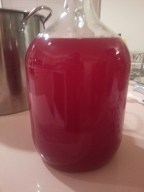 A
A 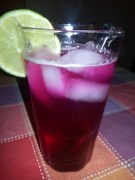 After the great harvest of prickly pears, my first and most immediate need was to thank those that supplied the fruit. While there will be wine and mead in the future, those are many months off and not the beverages of choice for everyone, so soda pop it is. Notice the little nod to my Midwestern upbringing. It has to start with the syrup; which by the way, can also be used for margaritas, lemonade, ice cream, or any number of things.
 I was fortunate enough to find myself with over 30 lbs. of prickly pears for various culinary and fermentable adventures. Thirty pounds is a lot of fruit and my carboys are full, but the season to pick this cactus fruit is now. So my first task is to preserve the fruit so that I could tackle these tasks at my leisure.
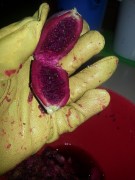 Speaking of gutting and skinning, I developed a method I had not yet seen before that seemed to work pretty well for me. Holding the fruit upside down, stab the fruit through just above the blossom and cut away from you toward the stem, cutting the fruit in half lengthwise. This way you have two fruit halves held together by the blossom. Use a spoon to clean it out like scraping the goody from an artichoke leaf; though the consistency of the raw fruit is more like eating a kiwi with a spoon. Keeping the two halves attached just makes it easier that trying to put down and pick up the halves with a bulky cumbersome leather glove.
 Don Dehm